Trees and lines
Trees are one of the leading causes of power outages across Auckland. When branches grow too close to power lines, they can cause faults, disrupt supply, and make it harder for crews to carry out repairs.
Together, we can help keep our network safe and reliable, and that starts with knowing your responsibilities when it comes to managing trees.
Contact Vector immediately if a tree or branch has fallen onto a line, a tree looks likely to fall onto a line, a line is down or hanging low, or branches are touching lines. Call 111 if there is an emergency. Never touch a power line or a tree or branch touching a line. If a line is down, stay at least 10 metres away and call 111.
Why Tree Management Matters
Overgrown or poorly placed trees can:
- Cause power outages, especially during high winds or storms.
- Slow down power restoration when outages occur.
- Put public safety at risk.
If you own a property with trees near power lines, you have responsibilities under the tree regulations. The Electricity (Hazards from Trees) Regulations 2003 outline the responsibilities of tree owners and Vector. The regulations were amended on 23 July 2026, with some changes taking effect later. If a tree is too close to a line, or could fall onto one, we may contact the tree owner and issue a notice where the regulations allow. It's important to note that the Tree Regulations only cover network lines and not your service line.
A tree can also be a risk if it could fall onto a power line. Being near a line does not automatically mean a tree is hazardous. We may assess a tree if its condition, size or location gives us reason for concern.
Working near power lines
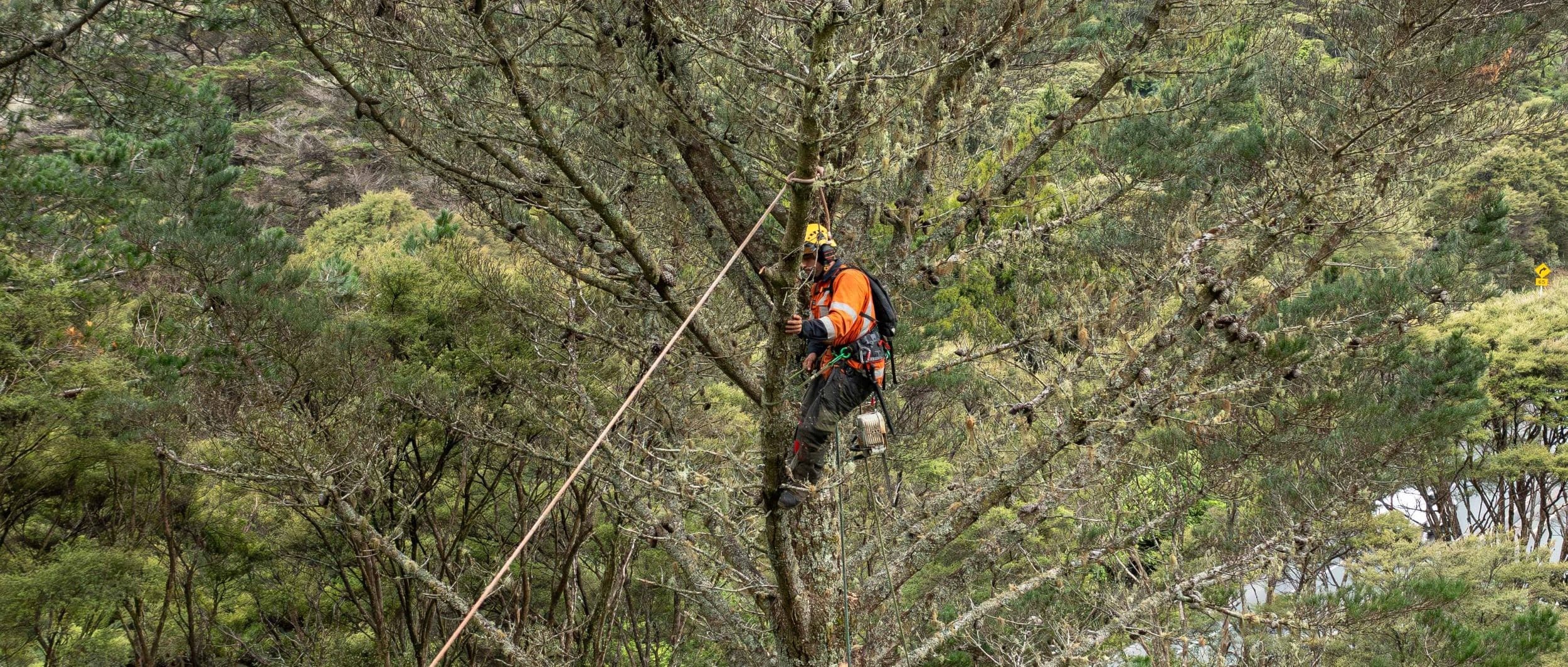
Trimming or felling trees around power lines is very dangerous and can result in electrocution or serious injury. Only qualified and approved utility arborists should trim trees within four metres of a network line. We call this the professional only zone.
Utility arborists approved to work within the professional only zone around our lines are:
- Treescape 0800 TREE WORK (0800 873 396)
- Asplundh 0800 4 ASPLUNDH (0800 4 277 583)
- Franklin Trees (0800 272 624)
A tree owner (or unapproved arborist) can only trim a tree when all parts of the tree are four metres or more away from our lines. It is also important the tree owner does not attempt to remove a tree or branch where the tree height or branch length is within the fall zone limit of the power lines.
You may not be aware, but as a property owner, under the Tree Regulations, you are legally required to keep any trees located on your property a safe distance from network lines (this excludes the service line that runs directly to your house).
Growth limit zone
You must keep your trees and vegetation clear of the growth limit zone around overhead network power lines. The size and shape of the growth limit zone depend on the voltage and, in some cases, the distance between poles. It's important to note that the Tree Regulations only cover network lines and not your service line.
Our responsibility is to let tree owners know that their trees are encroaching the growth limit zone when we become aware that they are, which we do by issuing tree owners with a “cut or trim notice”. If a tree is encroaching, it must be trimmed back to the cut-back zone which extends one metre beyond the growth limit zone. This is a minimum requirement, but to save on ongoing costs it might be more practical to have your tree removed or trimmed further back.
The zones around a power line
The growth limit zone is the space around a power line that must stay clear of trees and other vegetation.
The cut-back zone extends one metre beyond the growth limit zone. If a tree enters the growth limit zone, it normally needs to be cut back to the cut-back zone, unless a dispensation applies.
The hazard warning notice zone extends two metres beyond the growth limit zone. We may issue a hazard warning notice when vegetation enters this zone, to warn that the tree is getting too close.
The treefall hazard zone extends 24 metres from the edge of the growth limit zone. A tree in this area may be assessed if its condition, size or location means it could fall onto a power line. Being inside the zone does not automatically mean a tree is hazardous or must be removed.
For some lines, the growth limit zone also extends upwards above the line; this is called clear to the sky. It applies to higher-voltage lines. From 17 October 2026, it also applies to lines at 11 kV or below outside urban areas.
Clearance distances
Overhead Line Voltage | Growth Limit Zone | Cut-back Zone | Hazard Warning Notice Zone |
|---|---|---|---|
Power lines (230-400 V) | 0.5 metres | 1.5 metres | 2.5 metres |
High Voltage Lines (6.6kV) | 1.6 metres | 2.6 metres | 3.6 metres |
High Voltage Lines (11kV) | 1.6 metres | 2.6 metres | 3.6 metres |
High Voltage Lines (33kV)* *Clear to the sky requirement | 2.5 metres | 3.5 metres | 4.5 metres |
Cut or Trim Notice
If a tree or other vegetation enters the growth limit zone, we may issue a cut or trim notice. The notice will explain what work is required and when it must be completed. As we may not have contact details of property owners, we request that tenants pass the information onto the property owner.
First cut is free
If a tree has not previously been trimmed by us and is not subject to a separate arrangement with us, then we will undertake the first cut at our cost. We will still require your signature on the cut or trim notice approving access to your property to carry out the required work.
We use professional arborists to do this work. In some cases, proper tree trimming techniques require that a tree is cut back further than the notice zone to protect the health of the tree or encourage growth away from the lines. Our arborists will talk to you about this before starting work. Care will be taken to manage the appearance of trimmed trees, however, the first priority is to meet the requirements of the Tree Regulations and provide safe clearance from lines and equipment.
Subsequent trimming is at the tree owner's cost
Following the first cut, the tree owner is responsible for any subsequent trimming and for the cost of that work. If you are required to trim a tree on your property, you must:
- Arrange for the tree to be trimmed within the timeframe specified in the cut or trim notice
- Employ an approved utility arborist (see our list above) to carry out the work
- Provide us with at least three working days' notice of the work and tell us the time and location of the work. This is to ensure that all activity close to network lines is adequately monitored.
Non-compliance with a Cut or Trim Notice
If you do not comply with a cut or trim notice within the period specified, you may be fined up to $10,000. If the offence continues, a further fine of up to $500 may apply for every day or part of a day. You could also be held liable for costs if our lines or equipment are damaged by your tree.
We are committed to complying with the Tree Regulations and keeping our network safe. Where a tree owner fails to comply with a cut or trim notice, we will escalate the matter to Energy Safety or, if an imminent risk to persons or property exists, we may carry out an emergency cut or trim. As the tree owner you will be liable for the costs of this emergency trim if you have failed to comply with a cut or trim notice issued for that tree.
Declaring ‘no interest' in trees on your property
If you do not want to be responsible for keeping a tree on your property trimmed in accordance with the Tree Regulations, you can declare ‘no interest' in a tree provided the following criteria are met:
- The tree was naturally sown; or
- At the time of planting, the property owner (current or previous) reasonably believed that the tree, when fully grown, would not interfere with any power lines or electricity conductor.
If the tree does not meet the criteria set out in the Tree Regulations then the ‘no interest' tree notice will have no effect and your obligations as a tree owner will continue to apply.
To declare ‘no interest' in a tree, you must notify us in writing. If you have already received a cut or trim notice in respect of a tree that you wish to declare ‘no interest' in, then you must provide notice to us within 10 working days.
If we receive a ‘no interest' tree notice, we may remove or trim the tree to an extent determined by us. Please note that the tree may be removed rather than trimmed if it is likely to cause an ongoing problem.
Dispensation
A tree owner is entitled to request a dispensation from a cut or trim notice. If you have already received a cut or trim notice that you wish dispensation from then you must apply within five working days.
When a tree owner requests a dispensation, we will consider the safety issues involved in allowing the tree to encroach the growth limit zone and a formal response to a dispensation application will be sent to the tree owner within five working days of receipt of an application.
If a dispensation is granted, a tree owner is not required to cut or trim the tree within the notice zone, however the tree owner must ensure that the tree does not encroach the growth limit zone beyond the dispensation zone (as agreed with us).
Please refer to the Tree Regulations for further details of dispensation.
Arbitrators
Some disputes under the tree regulations can be referred to the Tree Arbitrator. The Tree Regulations provide that a tree owner may apply to an arbitrator to determine a dispute if:
- The network owner has refused to grant a dispensation which the tree owner believes should have been granted; or
- A dispensation has been granted but the tree owner does not agree with its terms.
The WorkSafe website lists the current Tree Arbitrator and further information. Some complaints may also be considered by Utilities Disputes.
Treefall Hazard Notices from 23 July 2028
The Treefall Hazard Zone extends 24 metres horizontally from the edge of the Growth Limit Zone. Being within the zone does not automatically mean a tree is hazardous or must be removed.
From 23 July 2028, if a tree within the treefall hazard zone is assessed as posing a moderate or high risk to a power line, we may issue a Treefall Hazard Notice requiring the tree to be removed. The assessment must include written advice from a suitably qualified and experienced arborist about the likelihood of the tree falling.
A high-hazard tree must be removed within 25 working days and a moderate-hazard tree within 45 working days. The tree owner is responsible for ensuring the tree is removed within the required timeframe and must tell us the time and location of the removal.
Vector will generally meet the reasonable costs of removing the tree and associated debris. If we offer to enter the property to remove the tree and the tree owner does not consent, we will no longer be required to meet the reasonable removal costs. We will also not be responsible for these costs where the tree was planted in breach of the Low Height Planting Zone requirements.
If a tree owner disagrees with a moderate or high hazard assessment, they will have 10 working days to apply to the Tree Arbitrator to dispute the assessment. The Tree Arbitrator will also be able to consider disputes about reasonable removal costs in certain circumstances.
We have responsibilities to ensure trees are kept at a safe distance from power lines. These include:
- Identifying trees growing inside the growth limit zone and issuing tree owners with cut or trim notices;
- Providing the ‘first cut', free of charge (unless the tree is covered by a previous arrangement or is part of a horticultural shelterbelt);
- Escalating matters to Energy Safety if tree owners don't comply with cut or trim notices;
- Carrying out tree trimming without delay where we determine that there is an immediate risk of danger to people or property from a tree’s proximity to our network lines (this may involve on-charging costs to a liable tree owner).
- Providing information about the rules
In addition to the work required by the Tree Regulations, where we identify a tree that could pose a hazard we may contact the tree owner to work with them to manage the risk.
Where we issue you a cut or trim notice, and the tree has not previously been trimmed by us and is not subject to a separate arrangement with us, then we will undertake the first cut at our cost. We will still require your signature on the cut or trim notice approving access to your property to carry out the required work. Note that subsequent trimming to the tree is your responsibility and cost.
We use professional arborists to do this work. In some cases, proper tree trimming techniques require that a tree is cut back further than the notice zone to protect the health of the tree or encourage growth away from the lines. Our arborists will talk to you about this before starting work. Care will be taken to manage the appearance of trimmed trees, however, the first priority is to meet the requirements of the Tree Regulations and provide safe clearance from lines and equipment.
We are committed to complying with the Tree Regulations and keeping our network safe. Where a tree owner fails to comply with a cut or trim notice, we will escalate the matter to Energy Safety or, if an imminent risk to persons or property exists, we may carry out an emergency cut or trim. As the tree owner you will be liable for the costs of this emergency trim if you have failed to comply with a cut or trim notice issued for that tree.
If we receive a ‘no interest' tree notice, we may remove or trim the tree to an extent determined by us. Please note that the tree may be removed rather than trimmed if it is likely to cause an ongoing problem.
To avoid the risk and future costs of trees growing too close to electricity lines, it makes good sense to consider tree species and growth rates carefully before planting new trees or vegetation on your property. For a list of suitable trees for planting under or near electricity lines, see our planting guide. For advice on native species most suitable to your region or habitat, contact Auckland Council on (09) 301 0101.
From 23 July 2027, new planting rules apply within the Low Height Planting Zone on unforested land outside urban areas. This zone extends horizontally up to 24 metres from a vertical line drawn from the power line conductor to the ground.
If you are an owner or occupier, you must not plant, or allow someone else to plant, a tree within this zone if you reasonably believe its mature height will exceed its distance from the power line.
The rule does not apply to existing forest land, urban areas, shelterbelts, or land administered under the Conservation Act 1987. If you are unsure whether your property is in an urban area, check your district plan or contact Auckland Council.
If you plant a tree in breach of this rule, you may be responsible for damage or the future cost of cutting, trimming or removing it. You cannot use a no-interest tree notice or apply for a dispensation for a tree planted unlawfully in the Low Height Planting Zone. The no-interest process is also unavailable where a self-sown tree becomes established in the zone and is not managed.