Hot water outage
There could be several reasons why you don’t have hot water:
- You may have experienced a power outage losing the ability to heat your water.
- Your terms of hot water supply may allow us or another third party to pause your hot water supply in order to control the load on the network.
- You may have an external load management device (pilot wire system or ripple relay) or internal load management device (smart meter).
Note: The pilot wire system covers North and West Auckland. Ripple relay applies to Central or South Auckland. Smart meters are gradually being deployed across all areas to modernise both systems.
There’s been a power outage and you now don’t have hot water:
If you live in Central or South Auckland, or if you have a smart meter, your hot water cylinder should automatically reheat when power is restored. Reheating can take up to six hours.
Power has been restored and hot water is still not available:
- Check that your hot water cylinder is switched on.
- If your hot water has not heated after six hours, please call us on 0508 832 867 as there may be an issue with your meter box or with your hot water tank.
- If your hot water cylinder is heated by gas, contact a registered plumber.
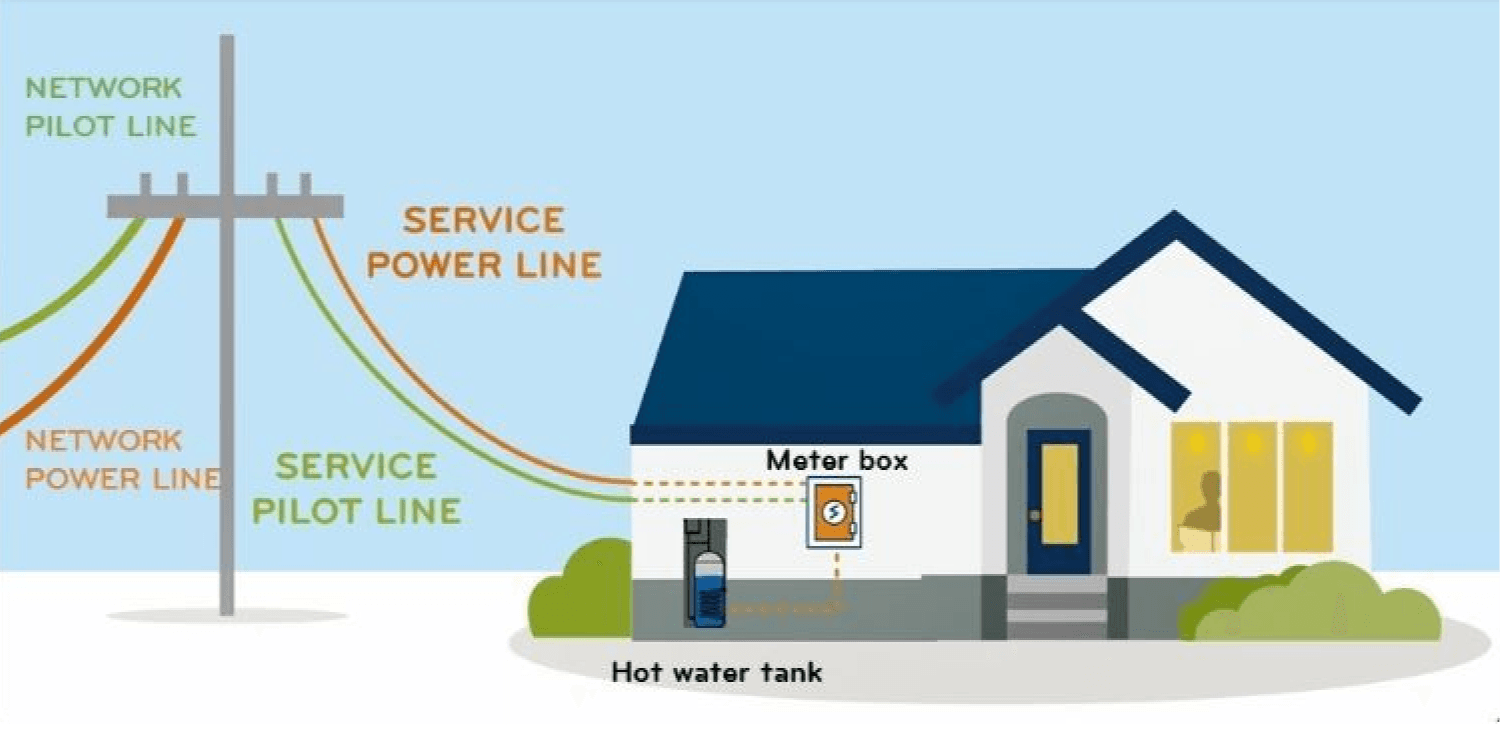
If you live in North or West Auckland, your hot water may be controlled by the pilot wire system, unless a smart meter has been installed. (As noted above smart meters are gradually being deployed across all areas to modernise both systems.) Hot water pilot wires are separate from power lines as shown by the image below.
Once your power has been restored after an outage, we then repair network pilot wires. If you are still without hot water once we’ve restored network pilot wires, there may be an issue with your service pilot wire or the pilot wire relay inside the meter box, please call us on 0508 832 867.
If there hasn’t been a power outage and you don’t have hot water: If your hot water cylinder is heated by electricity, call an electrician, or if it’s heated by gas, call a plumber.
FAQs
During a major outage, priority will be given to restoring the main power before hot water (explained below – see “How is hot water restored after a storm?”).
It can take up to six hours for a hot water cylinder to reheat once power has been restored after an outage. If you have no hot water after six hours:
- Check that your hot water cylinder is on
- If your hot water cylinder is heated by gas then contact a registered plumber
- If your hot water cylinder is heated by electricity then please call us on 0508 832 867.
Depending on the extent of the damage caused by a storm or major outage, some customers on the North Shore, Waitakere and Rodney (pilot wires) may be without hot water until we’ve restored power to all customers. Once this is done, then our crews will start working on restoring hot water.
There are two types of hot water load management devices on Vector’s electricity network – one is external to the electricity meter and the other is internal, within the electricity meter itself.
The external load management device (i.e. pilot wire system or ripple relay) is remotely controlled via the electricity network. The internal load management device (i.e. smart meter with integrated load management) can be controlled by Vector via the ripple system, cellular or radio signals. More information on Smart Metering can be found here: EGP503 Smart Metering Guideline.
When there are widespread outages caused by storms or other major events, priority is given to restoring main power lines first as they supply power to lights and other electrical appliances in homes. Hot water for customers can then be remotely turned on by load management devices again once the main power lines are restored.
Things are a bit more complicated for customers whose hot water is controlled by pilot relays (this system covers West and North Auckland, unless smart meters have superseded it). Even when outages on the main power lines are resolved, our field crews must restore the pilot circuits as well in order to get hot water going again.
There are times when demand for electricity becomes very high and results in more electricity than usual being used across the network. This occurs most often in winter, especially in the morning or early evening as people wake up or arrive home from work and turn on heaters, lights and start cooking (known as peak times). There may also be times when Transpower, or another electricity industry participant, requests Vector to reduce the electricity demand.
At those times Vector can temporarily turn off hot water heating to reduce the electricity demand across the network. This is called load management and has been used throughout NZ since the 1950’s.
When power demand eases (e.g., peak time ends), we send out a signal that switches hot water cylinders back on.
Customers on a price plan where we can control their nominated controlled load pay a lower price for line charges than those who do not allow control. All arrangements to move to or from a controlled price plan must be made through your electricity retailer. Costs may apply.
The time period that hot water will be turned off will vary depending on the amount of load that needs to be reduced.
When used, load management typically affects a customer for less than three hours. But if needed, it is sometimes used for up to five hours across the period a day (i.e. may be used in both the morning and evening period, with reheating in the periods between). Under some extreme weather conditions this time may need to be extended (e.g. if the electricity network has been damaged and needs to be repaired). This is because priority is given to restoring power before hot water.
To minimise potential effects on customers, load management is shared between customers, and is spread throughout the day rather than occurring in a single continuous period.
Customers can choose a price plan where Vector does not control their hot water however these Customers pay a higher price for line charges than those who allow control of hot water.
There may be additional costs to have any existing load management devices disabled or removed when moving from a controlled pricing plan to an uncontrolled pricing plan. Each of these facilities is arranged through the electricity retailer
In Auckland, most parts of Rodney, Manukau, and parts of Papakura a system known as ripple control is used in these areas.
Once power usage reaches maximum limits, the computerised system in our network control room sends out coded signals across the network. When the signal reaches a household meter board a relay recognises the signal and switches off the electricity supply to the hot water cylinder.
When power demand eases, another signal is sent out to turn the hot water cylinders back on.
In North Shore, Waitakere, and parts of Rodney a system known as the pilot wire system is used. Once power usage reaches maximum limits, the computerised system in our network control room sends out signals to the relevant substations around the region. These substations have switches which then send out the load management instruction over a separate wire from the mains supply. This wire is connected to a relay in a household meter board, and once it receives the instruction the relay wire switches off electricity supply to the hot water cylinder.
When power demand eases, another signal is sent out to turn the hot water cylinders back on.
No. A centralised computer system determines where and how much load management needs to occur. Load management is then shared across customers (i.e. off for one hour, on the next, etc) to minimise any potential effects on these customers.
Most household hot water cylinders will take around six hours to heat up if all the hot water has been used. Whilst the hot water cylinder goes off instantly in an outage there will still be hot (or at least warm) water in the hot water cylinder that can be used, especially if the outage is only a few hours. If you do not draw very much hot water during the outage period, you may not even experience any break in hot water supply.
Remember, during load management, the re-heating won’t start until the ‘on’ signal is sent. If you use all the hot water stored in your cylinder at the start of the load management period, the water won’t start to be reheated until the load management period is finished. This will add extra time to the water being reheated, depending on how long until the end of the load management period.
No. In fact, there may be marginally less electricity used overall if reheating a cold cylinder than keeping a cylinder at the temperature set point with uninterrupted electricity supply.
When using electric hot water, electricity is used to pre-heat a large water storage cylinder to about 55+ degree. The hot water from the cylinder is used as required in your home (e.g. bathroom and kitchen taps). Rather than burdening the electricity network with heating the hot water cylinder every time the hot water tap is used, the electricity supplying the heating element can be controlled to heat during off peak times, to help reduce the amount of electricity being used at that time. Essentially, it is a simple, effective way of flattening out the peaks and troughs of demand for electricity.
If your hot water cylinder is greater than 50 litres in water capacity with an electric heating element greater than 1.2 kilowatts, you qualify to have your hot water controlled via an appropriate smart meter. If a smart meter cannot be installed an external ripple relay may be used. When installing a smart meter, the hot water circuit must be wired into a separate controllable element of the meter.
Please see more information on smart hot water here
Hot water load management via the smart meter needs to be arranged via your chosen electricity retailer. More information on smart metering can be found here: EGP503 Smart Metering Guideline