Solar lights the bridge at night
09 May 2017
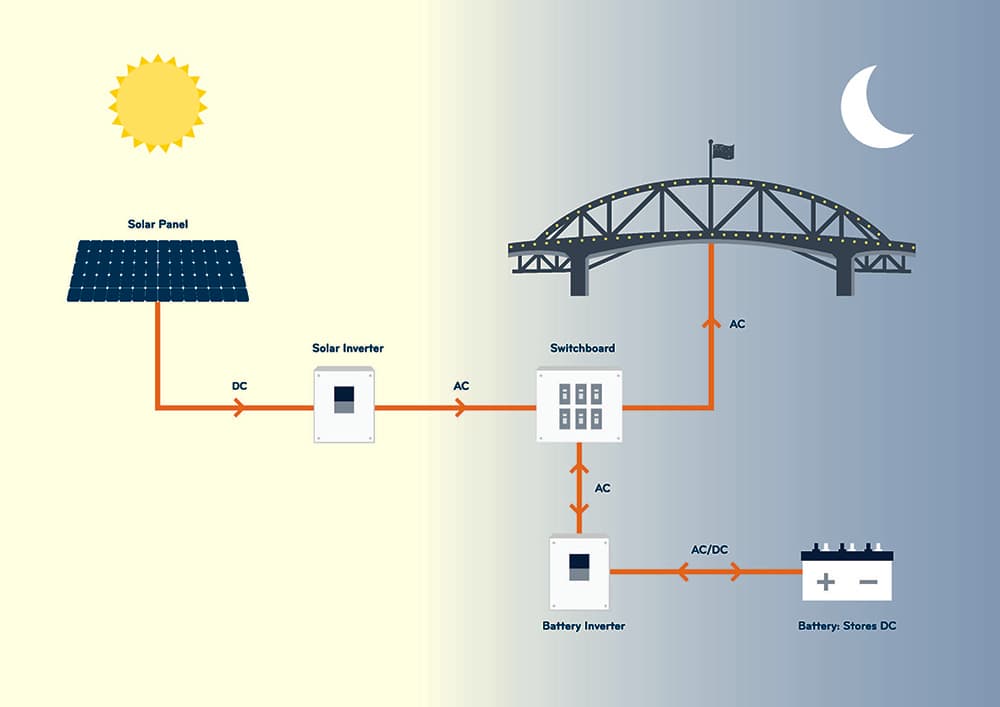
The Auckland Harbour Bridge will have its street lights and new event lights powered by photovoltaic (PV) solar energy at night, stored during the day in batteries. This innovative use of clean energy makes the bridge a world first and puts Auckland on the map as a creative and innovative city.
In partnership Auckland Council and Vector have a clean energy vision for Auckland in line with New Zealand’s target to reduce carbon emissions to 30% below 2005 levels, by 2030. This target is equivalent to 11% below 1990 levels by 20301.
The use of solar PV panels to generate electricity is a small but growing segment of clean energy in New Zealand, with generation doubling from 2014 to 20152.
Sunlight is converted to electricity by PV cells in the solar panels and an inverter then converts the alternating current (AC) power into direct current (DC) for storage in Vector’s battery storage system. The inverter converts the stored DC to AC to light the bridge when it gets dark.
The battery storage system used to power up the bridge is the same technology that Vector has used in its Glen Innes substation, the home of Asia Pacific's first grid-scale battery storage system to be integrated into a public electricity network.
Vector, in partnership with Auckland Council and in collaboration with the NZ transport agency, is excited to be lighting the Harbour Bridge with smart energy technology. This article is one in a series about the Vector Lights project. See more here.
Sources:
- Ministry for the Environment, New Zealand’s 2030 climate change target http://www.mfe.govt.nz/climate-change/reducing-greenhouse-gas-emissions/new-zealand%E2%80%99s-post-2020-climate-change-target
- Ministry of Business, Innovation & Employment 2016, Energy in New Zealand: 2015 Calendar Year Edition http://www.mbie.govt.nz/info-services/sectors-industries/energy/energy-data-modelling/publications/energy-in-new-zealand